

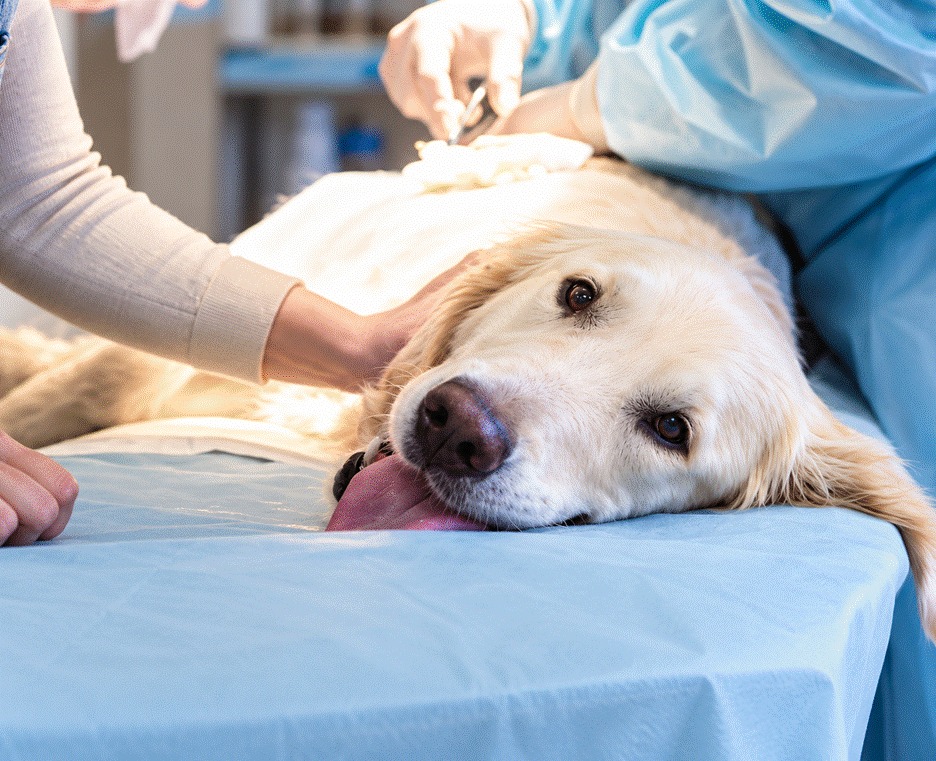
What is a cystotomy? It’s surgery that opens the bladder so a veterinarian can remove stones by hand and send them for analysis. Dogs need it when stones can’t be dissolved with a diet, are too large to flush out, or block urine flow. Stone type decides whether surgery is the first choice.
Two facts shape every bladder stone case. The first is what the stone is made of, because some types dissolve and others never will. The second is whether urine can still get out, because a blocked urethra turns a planned procedure into an emergency.
What Is a Cystotomy? A Closer Look at the Procedure
During a cystotomy, the dog is under general anesthesia while the surgeon opens the abdomen, then the bladder, and removes the stones. Our surgery team performs the procedure, and removed stones can be sent for analysis. According to the Merck Veterinary Manual’s overview of urolithiasis, knowing a stone’s composition matters both for deciding on dissolution and for preventing stones from coming back.
Bladder stone surgery for dogs isn’t the only way to get stones out. Merck lists less invasive options, including voiding urohydropropulsion, a technique that flushes small stones out through the urethra under anesthesia, and cystoscopic or laser methods that need specialized equipment. Merck notes that nonsurgical removal is preferred when possible because suture in the bladder can itself trigger new stones.
The Stone Types Behind Bladder Stone Surgery for Dogs
Struvite and calcium oxalate are the two most common stone types in dogs, and their share has shifted. A 2024 study in the Journal of Veterinary Internal Medicine reports, citing Minnesota Urolith Center submissions, that over 20 years struvite fell from 45.5 percent to 41.9 percent of canine stones while calcium oxalate rose from 40.9 percent to 45.2 percent.
The Merck Veterinary Manual’s guide to urolithiasis in dogs explains why the type matters so much. Struvite stones in dogs usually form with a urinary tract infection caused by urease-producing bacteria, and they can be dissolved medically. Calcium oxalate stones can’t be dissolved and must be mechanically removed. Merck lists small breeds such as the Miniature Schnauzer, Chihuahua, Bichon Frise, Yorkshire Terrier, Shih Tzu, and Lhasa Apso among those more commonly affected by calcium oxalate stones.
Less common types have their own patterns. Merck notes that Dalmatians are prone to urate stones, and that urate stones in a breed not known for them should prompt testing for a liver shunt. Cystine stones occur in breeds such as English Bulldogs, Mastiffs, French Bulldogs, and Newfoundlands.
Dog Bladder Stones Symptoms Worth Acting On
Merck describes the typical signs as painful or difficult urination, blood in the urine, and straining. Watch for these dog bladder stones symptoms at home:
● Straining: posturing to urinate with little or no urine coming out.
● Blood in the urine: pink, red, or blood-tinged urine.
● Painful or difficult urination: visible discomfort or repeated attempts to pass urine.
● No urine at all: a dog who strains and produces nothing needs to be seen immediately, since Merck classifies urethral obstruction as an emergency.
According to Merck, radio dense stones larger than 3 mm usually show up on X-rays, while urate and some cystine stones may need ultrasound or contrast imaging to confirm. Our on-site diagnostics include the in-house lab work, digital X-rays, and ultrasound used to start that workup.
How Vets Decide Between Surgery and Dissolution
The ACVIM consensus recommendations on uroliths state that struvite stones should be medically dissolved, because dissolution is highly effective and avoids the risks of anesthesia and surgery. Its lead author disclosed research grants from Hill’s Pet Nutrition. Merck adds that urethral obstruction, hyperlipidemia, and pancreatitis rule out dissolution diets, and that stones that fail to shrink after one to two months of treatment are probably not struvite.
| Factor | Cystotomy (Surgery) | Medical Dissolution |
| Stone types | Any type, including calcium oxalate | Struvite, urate, and cystine in suitable cases |
| Timeline | Stones removed in one procedure | Struvite bladder stones dissolve in 1 to 2 months on average |
| Stone analysis | Removed stones can be analyzed | Composition is presumed until confirmed |
| Key consideration | Requires anesthesia and surgery | Not an option with a urethral blockage, pancreatitis, or hyperlipidemia |
Diet is central to both paths. Our nutritional counseling helps set up a dissolution or prevention diet, and older dogs with other health problems may be evaluated through senior pet health care before anesthesia is planned.
Cystotomy Recovery Time and What Affects It
Cystotomy recovery time depends on the individual dog and what the surgery involved, so your vet sets the activity restriction and recheck plan. Our guide on keeping your dog or cat comfortable after surgery covers bedding, confinement, and incision care.
Call your vet if your dog strains, produces no urine, or seems to be in pain during recovery. Those signs are worth checking the same day.
The Limits of Surgery
Removing stones doesn’t stop new ones from forming. Merck calls recurrence a major problem with calcium oxalate stones and says it should be expected, since prevention aims to slow recurrence and catch new stones while they’re small enough to remove without surgery. The ACVIM panel also cites the high recurrence rate of calcium oxalate stones as the reason for long-term monitoring.
Struvite can come back as well. Merck notes that when infection-induced struvite does recur, it typically results from incomplete removal of stones or a returning urinary infection, so treating the infection is a key prevention step. For more on the procedure itself, see our page on bladder stone removal.
Getting Answers on Bladder Stones
Bring a fresh urine sample if you can, along with a note of when the straining or blood started. Those details shape the first decision between dissolution and surgery.
Kainer Veterinary Hospital evaluates dogs with urinary signs using in-house lab work, digital X-rays, and ultrasound, then builds a plan around the stone type. Contact us today if your dog is straining or has blood in the urine.
Sources
Lulich et al., ACVIM Small Animal Consensus Recommendations on the Treatment and Prevention of Uroliths, Journal of Veterinary Internal Medicine (2016). Supports medical dissolution of struvite and long-term monitoring of calcium oxalate. The lead author disclosed research grants from Hill’s Pet Nutrition.
Merck Veterinary Manual, Overview of Urolithiasis in Small Animals (2025). Supports the signs, X-ray detection, removal options, and suture-related recurrence.
Merck Veterinary Manual, Urolithiasis in Dogs (2025, updated 2026). Supports stone types, breed risk, dissolution timing, contraindications, and recurrence.
Manoharan et al., Journal of Veterinary Internal Medicine (2024). Supports the 20-year shift in struvite and calcium oxalate prevalence.
FAQs
Q: What is a cystotomy and when does a dog need one?
A: A cystotomy is surgery that opens the bladder to remove stones. It’s used for stones that can’t be dissolved, like calcium oxalate, for stones too large to flush out, and when dissolution isn’t safe or hasn’t worked.
Q: Is a cystotomy the same thing as bladder stone surgery for dogs?
A: A cystotomy is the standard form of bladder stone surgery for dogs. Less invasive options, such as voiding urohydropropulsion or cystoscopic removal, may work for small stones.
Q: What affects cystotomy recovery time?
A: Cystotomy recovery time varies with the dog and the case, so your vet sets the activity restriction and recheck plan. Contact your vet right away about straining, pain, or no urine.
Q: Will my dog need surgery again if stones come back?
A: Not always. Merck notes that monitoring can catch new stones while they’re small enough to remove without surgery, which also avoids the suture-related recurrence risk.
Q: What happens if bladder stones are left untreated?
A: Stones can keep irritating the bladder and can move into the urethra and block it. Merck classifies urethral obstruction as an emergency, so a dog straining without producing urine needs immediate care.