

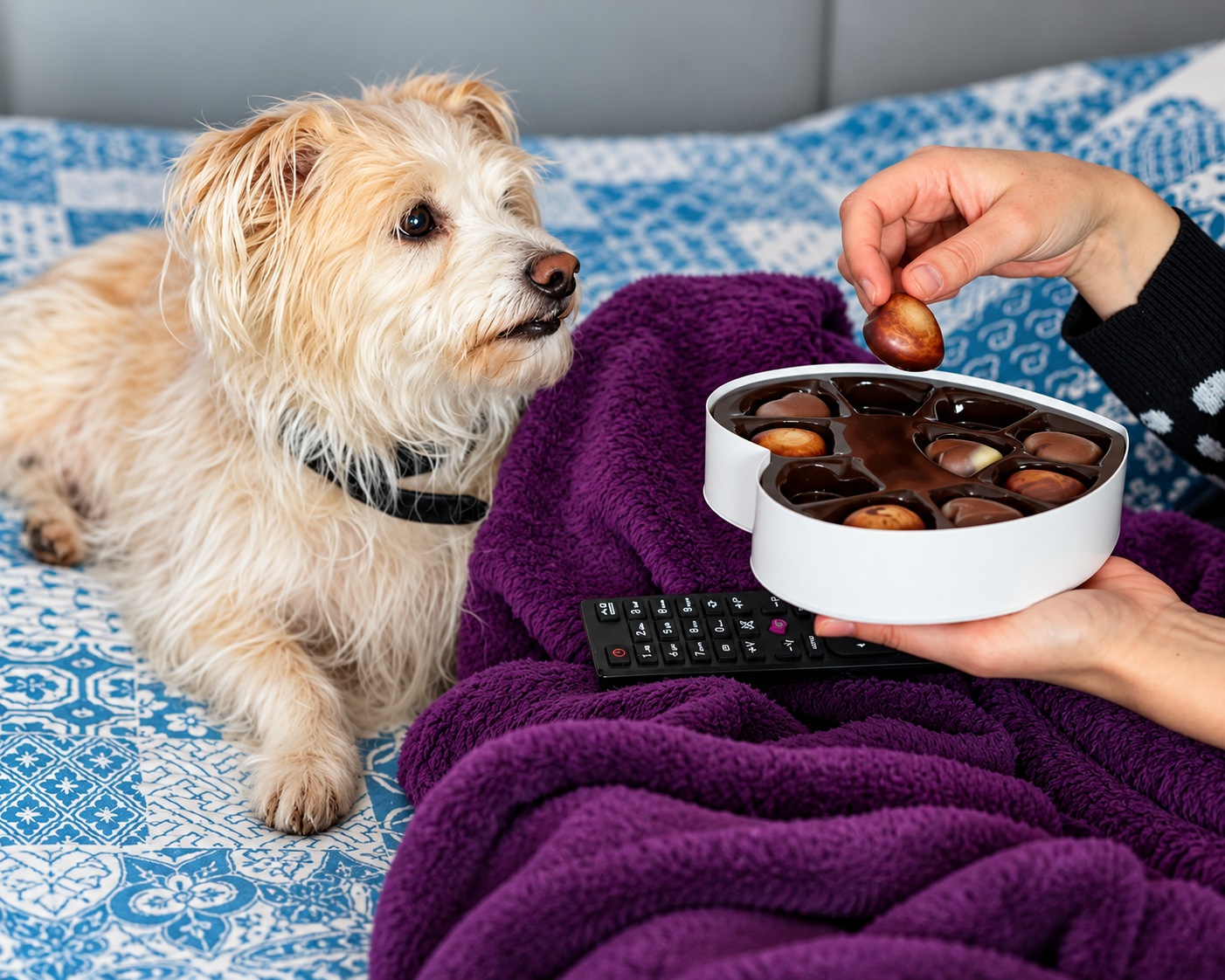
Your dog just got into the Halloween chocolate, so your first question is probably: What are signs of chocolate poisoning in dogs? Early signs can include vomiting, diarrhea, extra thirst, a swollen belly, and restlessness, usually within 6 to 12 hours of eating chocolate, according to the Merck Veterinary Manual. Hyperactivity, tremors, a racing heart, and seizures can follow.
If this is happening right now, take a breath and call your veterinarian before any signs show. Acting early can make a real difference. It can happen in any home with a candy bowl, and chocolate made up 13.6 percent of the pet toxin exposures reported to ASPCA Poison Control in 2025, ranking fourth on its list. ASPCA names dogs as the usual culprits and notes that cats may sample chocolate but are unlikely to eat large amounts, so this guide focuses on dogs.
Why Halloween Starts the Chocolate Season for Dogs
Halloween opens the stretch of the year when chocolate problems become more common for pets. Pet Poison Helpline reports a sharp increase in calls around Halloween, usually about pets that ate candy or décor, and says chocolate is consistently its number one call each year.
Claims data from the pet insurer Trupanion points the same way. More than a third of its chocolate toxicity claims fall in October, November, and December, and Trupanion says claims start to rise around Halloween. Across its chocolate toxicity claims in the US and Canada since 2020, Trupanion counted 543 in September, 628 in October, 789 in November, and 1,552 in December. Texas accounted for 192 of those claims. December is the highest month by a wide margin, and October is the first step up.
Insurance claims cannot explain the climb, but leftover candy, holiday baking, and gift boxes can all keep chocolate within a dog’s reach for weeks. For a wider list of risky foods, our guide to common foods and chemicals that are poisonous to pets covers grapes, onions, and household cleaners.
What Are Signs of Chocolate Poisoning in Dogs at Each Stage
Signs change over the hours after a dog eats chocolate. Merck describes early signs that can progress to nervous system and heart effects, and Pet Poison Helpline describes a delayed risk of pancreatitis, which is inflammation of the pancreas, from sugary, high-fat candy.
| Timeframe | What You May Notice | What to Do |
| Right after eating | Your dog may act completely normal | Call your vet now, before signs start |
| Within 6 to 12 hours | Increased thirst, vomiting, diarrhea, a swollen belly, restlessness | Call your vet right away |
| As signs progress | Hyperactivity, frequent urination, wobbly walking, stiffness, tremors, a fast or irregular heartbeat, fast breathing | Get your dog seen by a vet now |
| Severe cases | Seizures, very high body temperature, unresponsiveness | Go to the nearest emergency animal hospital |
| 2 to 4 days later | Poor appetite, vomiting, diarrhea, low energy, belly pain, which can point to pancreatitis | Call your vet for an exam |
Theobromine, the main stimulant in chocolate, leaves a dog’s body slowly. Its half-life in dogs, the time the body needs to clear half of it, is 17.5 hours, compared with 4.5 hours for caffeine. A dog that looks fine 2 hours after eating chocolate is not in the clear yet. For other problems, our article on recognizing when a pet needs immediate attention explains how to judge urgency.
What Decides Chocolate Toxicity for Dogs
Chocolate toxicity for dogs comes from two stimulants, theobromine and caffeine, which Merck identifies as the toxic ingredients. How sick a dog gets depends on the type of chocolate, how much was eaten, and the dog’s size. The same chocolate bar is a bigger problem for a Chihuahua than for a Labrador. The milder signs are vomiting, diarrhea, and extra thirst, with heart effects and seizures at higher amounts.
Type matters because stimulant content varies widely. Cocoa powder is highest, followed by unsweetened baking chocolate, dark and semisweet chocolate, and milk chocolate, and white chocolate is a negligible source. Low stimulant content does not make white chocolate harmless, though, because the high fat in chocolate products can trigger pancreatitis in susceptible animals.
Amount charts are left out of this guide on purpose. How much is too much depends on the exact product, your dog’s weight, and their health, so a veterinarian should work it out from the wrapper and your dog’s details.
At the severe end, death is generally due to heart rhythm problems, overheating, or breathing failure. If your dog has a heart condition, tell your vet when you call. Our guide on why early detection of heart disease in pets matters covers the signs of heart trouble to watch for.
Dog Poisoning Symptoms From Other Halloween Candy
A trick-or-treat bag holds more than chocolate, and other candy can cause dog poisoning symptoms that overlap with chocolate’s. Pet Poison Helpline names four food-related Halloween hazards: chocolate, candy overindulgence, raisins, and candy wrappers.
Raisins are easy to overlook. Some households hand out small boxes of raisins in place of candy, and very small amounts of raisins and grapes can cause kidney failure in dogs. Sugar-free candy and gum may contain xylitol, a sugar substitute that ASPCA lists among the items making up the largest part of its 2025 food and drink exposures.
Wrappers add a physical risk. Dogs usually swallow candy with the wrapper still on, and foil and cellophane can cause an intestinal blockage that may need surgery. Our guide on what to do when a dog swallows a foreign object covers the warning signs of a blockage.
What to Do If You Think Your Dog Ate Chocolate

Finding chocolate wrappers on the floor is stressful, and it is natural to want to wait and see. Call your veterinarian right away instead, even if your dog seems fine and even if the amount was small. Merck’s key points say early treatment to clear chocolate from the digestive tract can lessen the severity of effects, so timing matters. The details below help your vet judge how serious the exposure is and how it compares with your dog’s size. Have them ready when you call:
- The wrapper or packaging: the product name and type of chocolate.
- How much is missing: count the wrappers or estimate what is gone from the bag.
- When it happened: the time you found it, or the last time the chocolate was untouched.
- Your dog’s weight: a recent number from a vet visit works.
- Anything else in the bag: raisins, sugar-free candy, or gum.
- Health history: heart conditions and any current medications.
Veterinarians diagnose chocolate poisoning from the exposure history and the signs, because no readily accessible test exists. That is why the details above matter. Chocolate can also cause dehydration and electrolyte changes, which are shifts in the body’s blood salts, and correcting them is part of treatment. Our on-site diagnostics include in-house lab testing for that kind of workup.
What Treatment Can and Cannot Do
Treatment for chocolate poisoning is supportive, which means it manages the effects while the body clears the stimulants. Merck describes controlling vomiting, tremors, seizures, and heart rhythm problems, giving fluids that help the stimulants leave through the urine, and monitoring the heart.
Veterinarians may induce vomiting, but it is usually considered only for a recent exposure in a dog that is still acting normal, such as within about 2 hours of eating the chocolate. Once signs start, care shifts to managing them, and in severe cases signs can persist for up to 72 hours.
Pancreatitis is a separate risk. It may not show up for 2 to 4 days after a dog eats large amounts of sugary, high-fat candy, so keep watching appetite and energy through the rest of the week.
The numbers in this guide have limits too. ASPCA’s share counts calls to its hotline, and Trupanion’s data covers only its roughly 1.1 million insured pets, so the true number of pets affected each Halloween is not known. None of the sources separates Halloween candy from other chocolate.
Halloween Dog Safety That Lasts Through December
Halloween dog safety comes down to access. Keep the candy bowl on a high shelf or behind a closed door when you are not handing out candy. Ask kids to store trick-or-treat bags in a closed room, and remind guests that purses and coat pockets left on the floor are within reach.
If you want your dog to join in, choose dog Halloween treats and keep them in a separate container from the family’s candy. Keep the same habits through Thanksgiving and December, when baking chocolate and holiday gift boxes come into the house.
A current weight on file helps if you ever need to call your vet about something your dog ate, and routine pet wellness exams are a simple time to record it.
A Calmer Halloween for Your Dog
Keep the wrapper, note the time, and call your vet early.
At Kainer Veterinary Hospital, our team provides wellness exams, on-site diagnostics, and exams for dogs that have eaten something they should not have. If you are looking for a veterinarian in Conroe, TX, we also serve pet families across The Woodlands, Montgomery, and surrounding communities. Contact us today to schedule a visit or to update your dog’s weight and records before the holidays.
Sources
Merck Veterinary Manual, Chocolate Toxicosis in Animals (reviewed 2024, updated 2026). Supports the toxic ingredients, sign timing and progression, duration, theobromine half-life, chocolate type ranking, pancreatitis risk, diagnosis, and supportive treatment. Written by a veterinarian at the ASPCA Animal Poison Control Center.
ASPCA, The Top 10 Toxins of 2025 (2026). Supports chocolate’s 13.6 percent share and fourth-place ranking, the dog and cat pattern, and xylitol among the largest food and drink exposures.
Pet Poison Helpline, Halloween Dangers to Dogs and Cats (updated 2026). Supports the Halloween call increase, chocolate as the top call, the four food hazards, raisin and wrapper risks, and the 2 to 4 day pancreatitis window.
Trupanion, Chocolate Toxicity Affects Nearly 8,300 Pets (October 27, 2025). Supports the October to December share of claims, the monthly counts since 2020, the Texas claim count, the rise around Halloween, and the 1.1 million insured pet base. This is data from a pet insurer and covers cats and dogs in the US and Canada.
FAQs
Q: What are signs of chocolate poisoning in dogs?
A: The earliest signs are digestive: vomiting, diarrhea, and extra thirst, often with a swollen belly and restlessness. Hyperactivity, wobbly walking, tremors, and a fast or irregular heartbeat suggest the effects are spreading, and seizures are an emergency. A dog can look normal at first, so call your veterinarian before any signs appear.
Q: Can a small piece of milk chocolate hurt a large dog?
A: It depends on the product, the amount, and your dog’s size. Milk chocolate carries less stimulant than dark or baking chocolate, and a large dog is affected less by a small amount than a small dog, but individual susceptibility varies. Call your vet with the wrapper and your dog’s weight instead of guessing.
Q: Is chocolate toxicity for dogs worse with dark chocolate?
A: Yes. Cocoa powder, baking chocolate, and dark chocolate carry the highest stimulant levels, milk chocolate carries less, and white chocolate carries very little. The amount eaten and your dog’s size also matter, so share the wrapper and your dog’s weight with your vet.
Q: Can other Halloween candy cause dog poisoning symptoms?
A: Yes. Raisins can cause kidney failure in dogs, sugar-free candy and gum may contain xylitol, and large amounts of sugary, high-fat candy can lead to pancreatitis. Wrappers can also cause an intestinal blockage. Tell your vet everything that was in the bag, including candy without chocolate.
Q: How do I keep Halloween candy away from my dog?
A: For Halloween dog safety, store candy in a closed cabinet or on a high shelf, keep trick-or-treat bags in a closed room, and watch purses and coats left on the floor. Offer your dog its own treats instead, and keep the same habits through Thanksgiving and December, when chocolate stays in the house.