

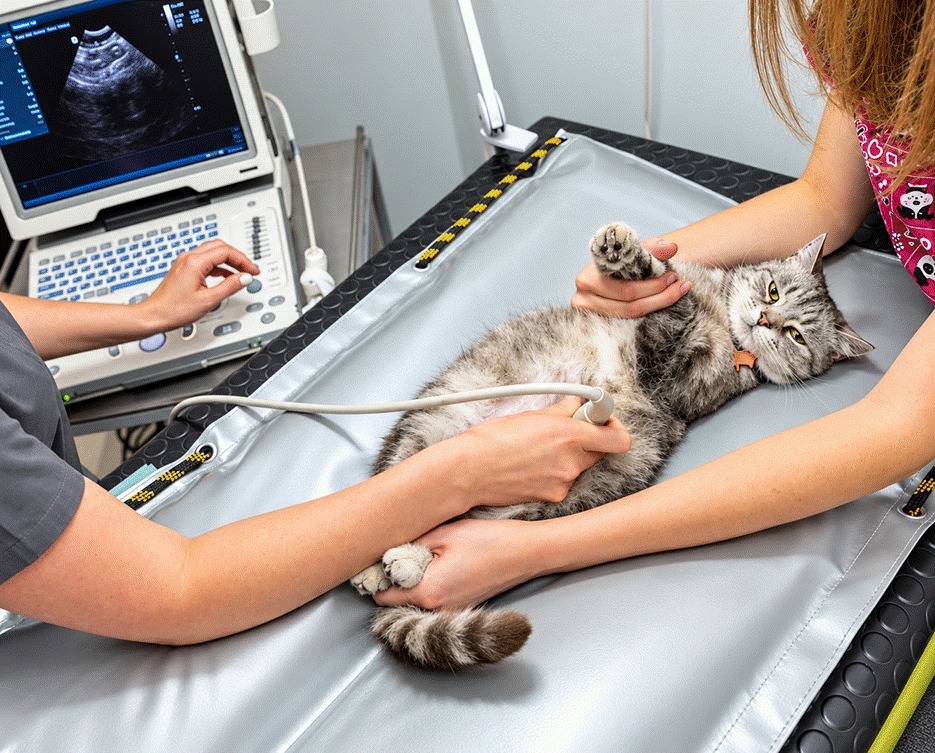
What does a cat echocardiogram show? It’s an ultrasound of the heart that shows wall thickness, chamber size, and how well the heart pumps. The ACVIM panel calls echocardiography the gold standard test for diagnosing cardiomyopathies in cats, including hypertrophic cardiomyopathy, a thickening of the heart muscle. A murmur alone can’t confirm or rule out heart disease.
The numbers explain why. In the CatScan study of 780 apparently healthy cats, 14.7 percent had hypertrophic cardiomyopathy, and the prevalence rose with age. The same paper notes that heart murmurs are common in healthy cats, and that a murmur’s sensitivity for detecting cardiomyopathy has been reported at only 31 to 61.3 percent.
What Does a Cat Echocardiogram Show?
An echocardiogram measures the thickness of the heart walls, the size of the left atrium, how strongly the heart contracts, and how blood flows through it. Those measurements let a vet classify the disease and stage it. Our echocardiogram service is part of our wider cardiology care.
The ACVIM consensus statement on feline cardiomyopathies stages disease from A, cats at risk, through D, heart failure that no longer responds to treatment. Stage B cats have heart disease but no signs, and the panel divides them into B1, at lower risk of heart failure or blood clots, and B2, at higher risk. Telling them apart takes imaging.
Why a Heart Murmur in Cats Isn’t a Reliable Warning Sign
A heart murmur in cats can come from a normal heart, and a cat with heart disease can have no murmur. The CatScan paper notes that murmurs reported in apparently healthy cats range from 15.5 to 33.7 percent, and that functional murmurs, which aren’t caused by heart disease, are common. That’s why the ACVIM panel relies on echocardiography to diagnose cardiomyopathy.
Signs at home can also be subtle. Our article on hidden symptoms of heart disease in cats covers the quieter changes that sometimes come first.
Cat Heart Disease Screening: Which Tests Do What
Cat heart disease screening can start in different places, and each test answers a different question.
| Test | What It Can Show | Limitation |
| Physical exam | Murmurs, gallop sounds, and irregular rhythms | A murmur can be present with a normal heart or absent with disease |
| NT-proBNP blood test | Higher levels with more advanced cardiomyopathy | A normal result doesn’t rule out mild disease |
| Echocardiogram | Wall thickness, atrial size, pumping, and blood flow | Shows the heart today, not when signs will start |
The ACVIM panel considers NT-proBNP an initial screening test for advanced cardiomyopathy and recommends that a positive result always be followed by an echocardiogram.
Cats That May Need Screening Earlier
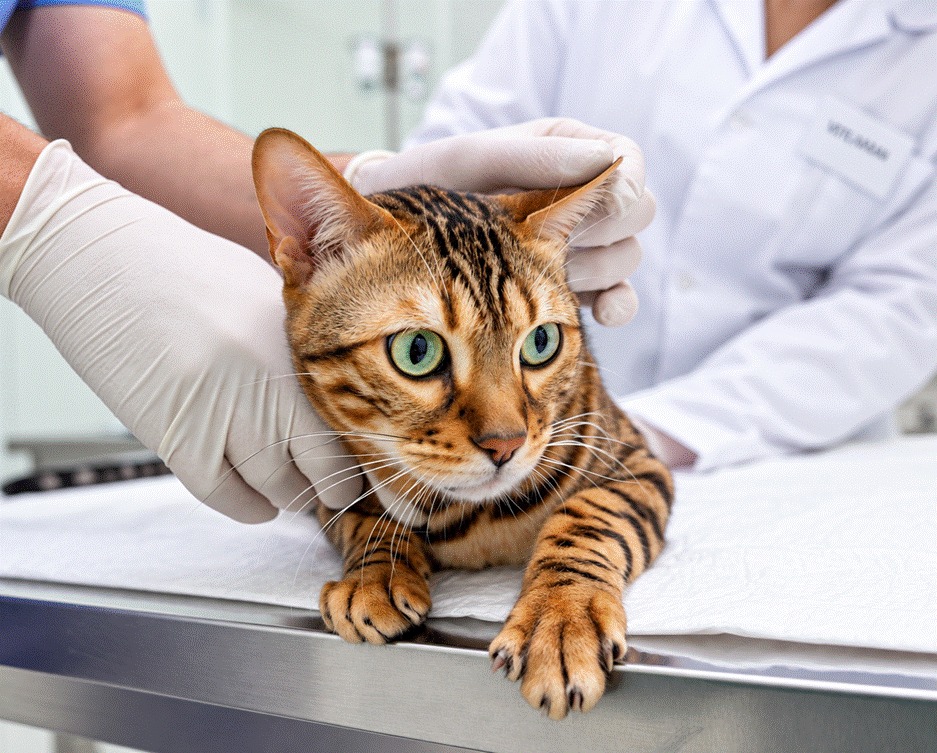
Risk isn’t spread evenly. Based on the ACVIM guidelines and the CatScan findings, discuss screening for:
- Maine Coon and Ragdoll cats: both breeds carry known genetic mutations linked to hypertrophic cardiomyopathy, and the ACVIM panel notes that cats testing negative have still developed the disease.
- Older cats: CatScan found that hypertrophic cardiomyopathy became more common with increasing age.
- Cats 9 or older before certain procedures: the ACVIM panel advises considering further testing before anesthesia, IV fluids, or extended-release steroid injections.
- Cats with a murmur, gallop sound, or irregular rhythm: these findings call for a closer look, even though a murmur alone isn’t diagnostic.
What Happens After Hypertrophic Cardiomyopathy in Cats Is Found
Hypertrophic cardiomyopathy in cats is managed by stage. The ACVIM panel recommends clopidogrel for cats considered at higher risk of arterial thromboembolism, a blood clot that can lodge in the legs. Cats that develop heart failure need treatment to control fluid buildup.
Breathing rate is a practical home check. A study of sleeping respiratory rates found that cats with stable, well-controlled heart failure had a median sleeping rate of 20 breaths per minute at home, and only one cat reached 30 or more. Count your cat’s breaths while asleep, and call your vet about a rate that stays at 30 or above, or that keeps rising. Our article on how congestive heart failure affects cats covers what that stage looks like.
What an Echocardiogram Can’t Tell You
An echocardiogram describes the heart at one point in time. It can’t predict exactly when a cat will develop heart failure or a blood clot, so cats with mild changes need rechecks on a schedule your vet sets. NT-proBNP has its own limits, since the ACVIM panel notes that a normal result doesn’t guarantee a cat is free of disease or won’t develop it.
The CatScan figures also come from cats in UK rehoming centers, so prevalence in other groups of cats may differ. For the echocardiogram’s role in dogs, see our guide to why an echocardiogram matters for dogs.
Looking Past the Stethoscope
If your cat has a murmur, a high-risk breed, or an upcoming anesthetic procedure, ask whether an echocardiogram or NT-proBNP test makes sense first.
At Kainer Veterinary Hospital, feline heart screening combines the physical exam, echocardiography, and other cardiac testing to stage heart disease before signs appear. Contact us today to ask about screening for your cat.
Sources
Luis Fuentes et al., ACVIM Consensus Statement on Feline Cardiomyopathies, Journal of Veterinary Internal Medicine (2020). Supports echocardiography as the gold standard, staging, NT-proBNP use and limits, testing before procedures, breed risk, and clopidogrel for high-risk cats.
Payne, Brodbelt, and Luis Fuentes, The CatScan Study, Journal of Veterinary Cardiology (2015). Supports the 14.7 percent prevalence, the rise with age, and the murmur figures.
Porciello et al., The Veterinary Journal (2016). Supports the median sleeping rate of 20 breaths per minute in cats with stable heart failure.
FAQs
Q: What does a cat echocardiogram show that a physical exam doesn’t?
A: It shows wall thickness, atrial size, pumping strength, and blood flow. A physical exam can detect a murmur or irregular rhythm but can’t show the cause.
Q: Is a heart murmur in cats always a sign of heart disease?
A: No. A heart murmur in cats can be functional, meaning the heart is normal, and cats with heart disease can have no murmur. Imaging is needed to tell the difference.
Q: Which cats need cat heart disease screening first?
A: Screening is worth discussing for Maine Coon and Ragdoll cats, older cats, cats with a murmur or irregular rhythm, and cats 9 or older before anesthesia, IV fluids, or long-acting steroid injections.
Q: How common is hypertrophic cardiomyopathy in cats?
A: In the CatScan study of 780 apparently healthy cats, 14.7 percent had hypertrophic cardiomyopathy, and it became more common with age.
Q: What happens if hypertrophic cardiomyopathy in cats is found?
A: Treatment depends on the stage. Cats at higher risk of blood clots may be started on clopidogrel, and cats in heart failure need treatment to control fluid. Your vet will set the recheck plan.
