
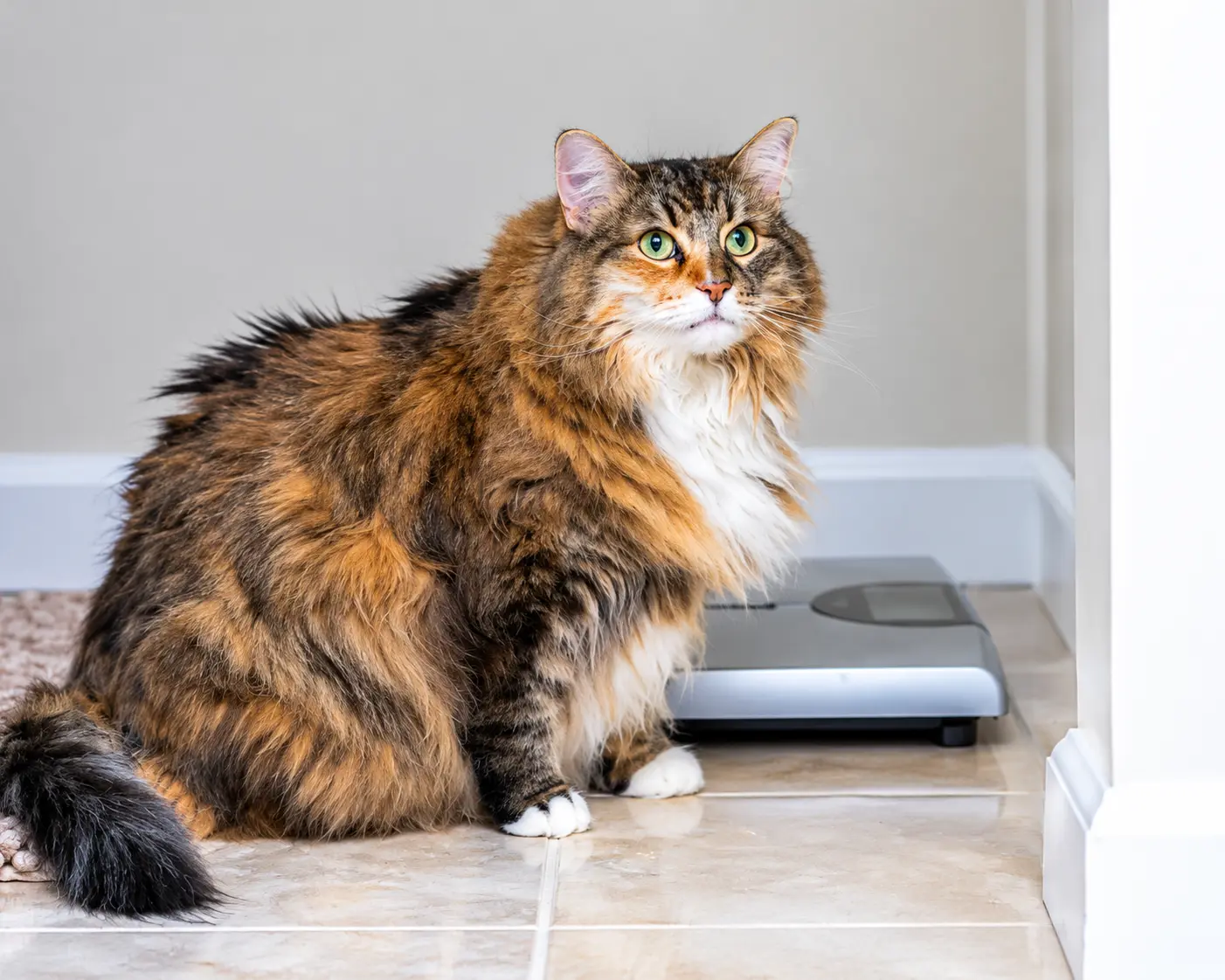
If you are wondering how to tell if my cat is overweight, you can check in about a minute without a scale. Run your hands along your cat’s sides: you should feel the ribs under a thin layer of padding, and from above you should see a waist behind the ribs. If you have to press to find the ribs, or your cat looks like a round loaf from above, there is probably extra weight, and the number on the scale will not say how much.
This guide covers why the scale alone can mislead, how to tell if my cat is overweight at home, what each body condition score looks like, why extra weight matters, what happens at a weight visit, and when to call the vet sooner.
Why the Scale Alone Can Mislead
A Number Needs a Reference Point
A scale reading tells you what your cat weighs today. It does not tell you whether that weight suits your cat’s frame. A number that would be heavy on a small, fine-boned cat can be lean on a large one, and a home bathroom scale is a coarse tool for an animal that weighs only a few pounds.
Vets get around this by estimating an ideal body weight for each individual cat and comparing the actual weight to it. VCA Animal Hospitals, in a client guide written by the Canadian Academy of Veterinary Nutrition and updated in March 2025, describes a cat as overweight at 10 to 20 percent above ideal weight and obese above 20 percent. Without an ideal weight to compare against, the number on its own cannot be graded. Your vet sets that reference point at a wellness exam, where your cat’s weight is recorded next to a body condition score.
What a Body Condition Score Measures
The tool most clinics use alongside the scale is a body condition score. The World Small Animal Veterinary Association publishes a nine point chart for cats, where 5 is ideal, scores 1 to 4 are under ideal, and scores 6 to 9 are over. A score comes from looking at the cat and feeling it: how easily the ribs can be felt, whether a waist shows behind the ribs, and whether the belly tucks up toward the back legs. Some clinics use a five point version of the same idea, where 3 is ideal, so it helps to ask which scale your vet is using.
The chart also makes room for individual cats. It notes that a 6 out of 9 may be acceptable in some cats, especially older ones, a life stage our post on maintaining a healthy weight for your senior pet covers in more depth. A score is a clinical judgment about one animal, tracked over time.
How to Tell If My Cat Is Overweight at Home
A hands-on check takes a couple of minutes with a relaxed cat, and it is the most reliable thing an owner can do between visits. It does not replace an exam, but it tells you what to ask about.
The Rib Check
Run your fingertips lightly along the side of your cat’s chest. At an ideal score, the ribs can be felt under a slight covering of fat. At a score of 6 they are felt beneath a slight excess of fat, at 7 they take more effort to find under moderate fat, and at 8 to 9 they are difficult or impossible to feel under heavy fat.
If you have to press firmly to find the ribs, tell your vet.
Waist and Belly From Above and the Side
Stand over your cat while it stands, and look down along the back. At an ideal score a waist is visible behind the ribs, though not pronounced. At 7 it is barely visible, and at 8 or 9 it is gone. Then look from the side. An ideal cat has a tuck, where the belly line rises toward the back legs. At 7 the tuck is absent and an obvious abdominal fat pad shows. At 9 the belly is distended and fat extends over the lower back, the face, and the limbs.
These are the signs that point toward extra weight:
- Ribs that can be felt only by pressing through a noticeable layer of fat.
- No visible waist when you look down at your standing cat from above.
- A belly line that stays level or rounds out from the side, with no tuck toward the back legs.
- A visible fat pad under the belly.
- Fat building over the lower back, which shows up at higher scores.
When Your Eyes Can Be Fooled
Long coats blur the outline, so the hands matter more than the eyes for fluffy cats. Some cats also carry a loose flap of skin along the lower belly that is normal anatomy and can swing when they walk, and a vet can tell it apart from fat in seconds. If you cannot tell which you are looking at, ask at your cat’s next preventive care visit.
What Each Body Condition Score Looks Like
The table below summarizes the World Small Animal Veterinary Association’s descriptions for the scores that matter most when an owner suspects extra weight. Treat it as a map for the conversation with your vet.
| Score | Ribs | Waist From Above | Belly From the Side |
| 4 (slightly lean) | Easily felt with minimal fat covering | Noticeable behind the ribs | Slight tuck, minimal belly fat |
| 5 (ideal) | Felt with a slight covering of fat | Visible behind the ribs, not pronounced | Tuck present, minimal belly fat |
| 6 (above ideal) | Felt beneath a slight excess of fat | Visible but not obvious | Tuck present but not obvious, slight rounding |
| 7 (overweight) | Felt with more difficulty beneath moderate fat | Barely seen or not easily seen | No tuck, rounded belly, obvious fat pad |
| 8 to 9 (obese) | Difficult or impossible to feel under heavy fat | Absent | Prominent rounding and fat over the lower back, with distension at 9 |
A score of 3 or lower is not shown because it points to the opposite problem. A cat that looks thin, or one that is losing weight without a change in feeding, needs a different kind of attention, and the section on when to call the vet covers that.
Why Extra Weight Matters
Joints, Blood Sugar, and Anesthesia
VCA‘s guide describes obesity as a chronic, low level inflammatory condition, because fat tissue releases inflammatory hormones. It lists higher risks for overweight and obese cats across several body systems: diabetes, osteoarthritis with faster joint degeneration, heart disease and high blood pressure, bladder stones, cancer, and complications under anesthesia. The last one matters for any cat that may someday need dental work or surgery.
Joints deserve a specific mention. In a 2023 review in Today’s Veterinary Practice, Dr. Michael Jaffe, a board certified veterinary surgeon, calls weight management the most important component of care for cats with osteoarthritis. Extra weight raises the load on every joint, and inflammatory substances released by fat may affect cartilage. That connection is also why pain management for an older cat includes a conversation about weight.
Diabetes is the other connection. If your cat is gaining weight and also drinking heavily or visiting the litter box more often, mention both at the visit, since those are common symptoms of diabetes in cats.
What Happens at a Weight Visit
The Exam and Baseline Testing
A weight visit starts with the same tools you used at home. The vet weighs your cat, assigns a body condition score, examines the cat from nose to tail, and estimates a target weight. Weight gain is not always only about food, so the vet may also recommend blood and urine testing to look for conditions that affect weight or that extra weight may have set off. On-site diagnostics at Kainer Veterinary Hospital include in-house lab testing with quick results, which can shorten the wait for those answers.
Why Crash Diets Are Dangerous for Cats
VCA’s guide states that obese cats that stop eating are at significant risk of hepatic lipidosis, a potentially life threatening liver condition often called fatty liver disease. It also notes that simply cutting back the current food can lead to micronutrient deficiencies over time, and that a plan has to be checked regularly so that loss is neither too fast nor too slow. If your cat starts eating much less after you cut the bowl, call your vet that week.
What a Supervised Plan Looks Like
According to the same guide, a supervised plan for cat weight loss typically includes a calorie restricted veterinary therapeutic diet, either a commercial product or a homemade recipe formulated by a veterinary nutritionist, with set portions, a consistent meal schedule, and tightly limited snacks. Monthly weigh ins confirm the pace of loss and track body condition. The guide also recommends a physical rehabilitation consultation for activity, and a maintenance food with strict portion control once the goal weight is reached, because regain is a real risk. Some cats stay on a therapeutic diet permanently at slightly higher portions.
The exact food and amounts depend on your cat’s age, health, and target weight, so they are not something this article can or should specify. Our post on the benefits of nutritional counseling for pets at every life stage explains how that conversation with a vet works.
When to Call the Vet Sooner
Most weight conversations can wait for a scheduled wellness exam, but some changes should not.
An overweight cat that stops eating, or eats far less than usual, should be seen promptly because of the fatty liver risk described above. Sudden weight gain, a belly that swells quickly, or a belly that feels tight or painful is not the same as slow, steady weight gain and needs an exam. Heavy thirst and frequent urination can signal diabetes or another condition. Reluctance to jump onto furniture, less grooming, or a change in how your cat stands in the litter box can be early signs of joint pain, which Dr. Jaffe notes usually shows up in cats as a behavior change, with little or no limping.
At the other end, a cat that is losing weight without a change in food, or one whose ribs have become easy to see, needs a visit for a different reason. Unexplained weight loss in a cat is a symptom worth investigating, and it is not a reason to wait.
Giving Your Cat a Healthier Shape
Checking your cat’s shape at home turns a vague worry into specific observations you can share. Feel the ribs, look for the waist and the belly tuck, write down what you see, and bring it to a wellness exam, where a body condition score and a target weight give the plan something solid to stand on. A healthy cat weight is not one number for every cat, and a safe route to it is gradual and supervised.
At Kainer Veterinary Hospital, our team provides wellness exams, on-site diagnostics, and nutritional counseling for cats and dogs. We serve pet families across The Woodlands, Conroe, Montgomery, and surrounding communities with personalized and compassionate care. Contact us today to schedule a wellness exam and talk through your cat’s weight.
Sources
- VCA Animal Hospitals offers a client guide, Obesity in Cats, written by Canadian Academy of Veterinary Nutrition authors and updated in March 2025, that defines overweight and obese ranges and covers health risks and supervised weight loss.
- The World Small Animal Veterinary Association nine point Body Condition Score Chart for Cats, updated in 2020 and hosted by the Virginia Tech Veterinary Teaching Hospital, describes each score from underweight to obese.
- Today’s Veterinary Practice published Michael Jaffe’s March/April 2023 article Diagnosis and Management of Feline Osteoarthritis, which reviews how arthritis shows up in cats and how it is managed.
FAQs
Q: How to tell if my cat is overweight without a scale?
A: Feel along the ribs and look at the waist and belly. At an ideal body condition score the ribs are felt under a slight covering of fat, a waist shows behind the ribs from above, and the belly tucks up toward the back legs from the side. If the ribs take firm pressure to find and the waist and tuck are gone, your cat is likely carrying extra weight.
Q: What is a healthy cat weight?
A: There is no single number, because frames differ. Vets estimate an ideal weight for each cat and pair it with a body condition score, where 5 out of 9 is ideal. Your vet can set a target weight for your cat specifically.
Q: Can I start cat weight loss on my own at home?
A: It is safer not to. An overweight cat that eats too little is at risk of hepatic lipidosis, a serious liver condition, so the pace has to be checked by a vet. A supervised plan usually combines a therapeutic diet, set portions, and regular weigh ins.
Q: Is an obese cat at higher risk of diabetes?
A: Yes. VCA’s guide lists diabetes among the conditions overweight and obese cats are more likely to develop, along with osteoarthritis, heart disease, and bladder stones. Excess thirst and frequent urination are reasons to book an exam.
Q: How often should an overweight cat be weighed during a diet?
A: According to VCA’s guidance, a supervised plan includes monthly weigh ins to confirm that weight is coming off at a safe pace and that body condition is improving. Your vet may adjust the plan based on those results.