

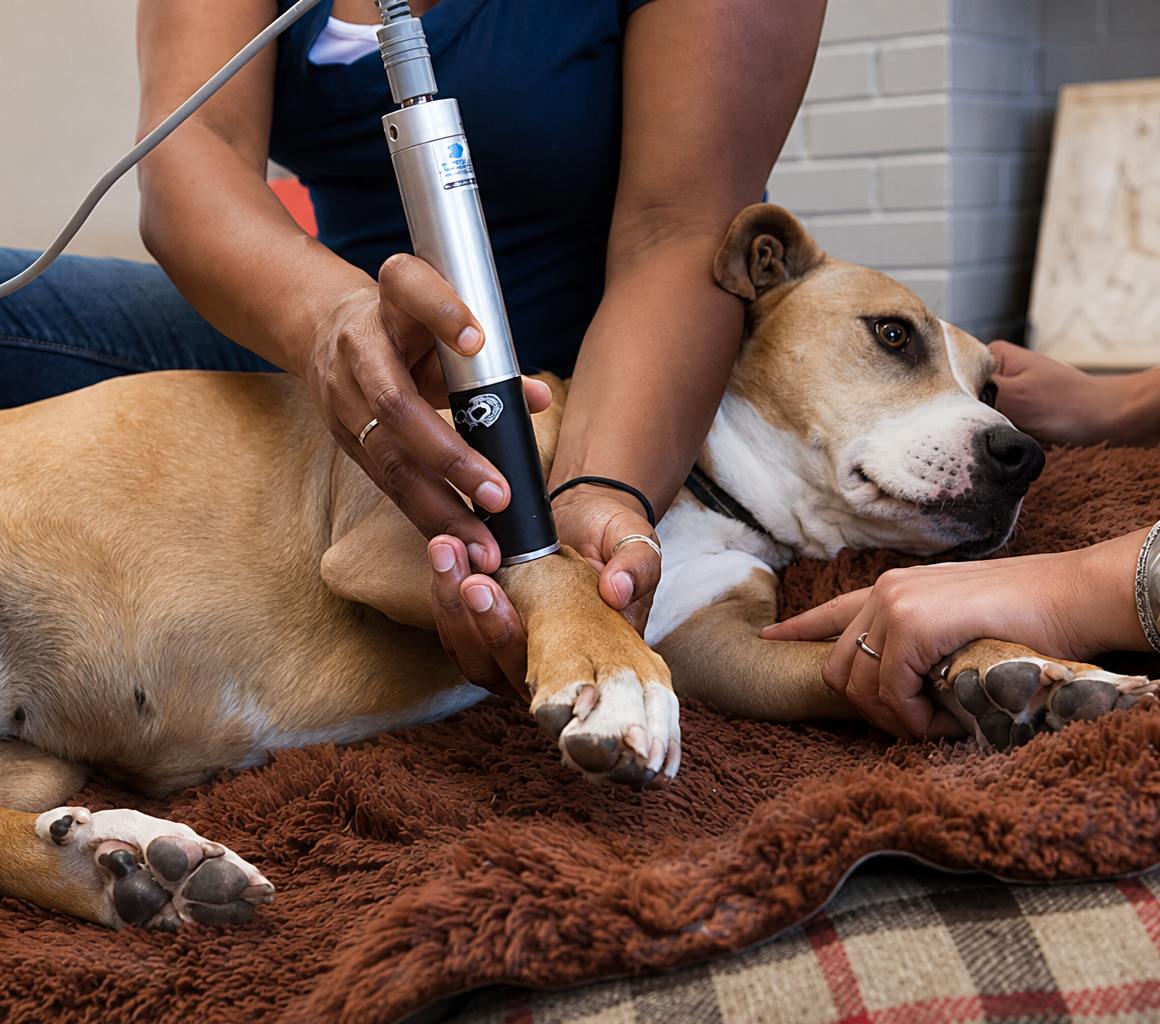
Cold laser therapy for dogs uses red and near-infrared light to reduce pain and support tissue repair, and it’s used alongside pain medication after surgery. Whether it speeds recovery is unsettled. In surgical trials in dogs, results have ranged from owner-reported gait improvement to no statistically significant difference.
You may have heard that laser therapy “speeds healing.” That’s a stronger claim than the surgical research supports so far. What the evidence does support is narrower and still useful, and this guide sets out both.
How Cold Laser Therapy for Dogs Works
At Kainer Veterinary Hospital, our cold laser therapy service is used for post-surgical discomfort, arthritis, wounds, and fractures, and it can be paired with acupuncture or veterinary orthopedic manipulation.
According to the Merck Veterinary Manual, laser therapy may reduce pain, relax muscles, and improve circulation. Light is absorbed by molecules in the mitochondria, and the effects on cells and tissue are called photobiomodulation. Merck lists post-surgical musculoskeletal pain, arthritis, fractures, and wound healing among the conditions where it has shown value.
Why “Cold” Isn’t Always Accurate
The name suggests the laser never warms tissue, but that depends on the device. Merck notes that higher-powered Class IV units routinely heat tissue, which makes the term “cold laser” inaccurate for them. Merck also notes that more intense beams tend to give stronger pain relief, while less intense light over a longer period tends to give better tissue healing results.
Pigment matters too. Melanin absorbs red light strongly, and Merck warns that concentrating a large amount of light on a small area raises the risk of overheating and burns. That’s why the person running the laser sets power and treatment time for each dog and each area.
What the Surgery Studies Found
The strongest evidence in dogs comes from knee surgery for a torn cranial cruciate ligament, a procedure called TPLO. Here’s how the main studies compare.
| Study | What It Measured | What It Found |
| 95 dogs after TPLO, Veterinary Surgery (2018) | Owner questionnaires, X-ray healing, and other outcomes | Some evidence that laser may improve gait as assessed by owners |
| 54 dogs after TPLO, randomized trial (2024) | Pain, weight bearing, and recovery measures | Showed promise, with no statistically significant difference |
| Review of 3 trials after TPLO (2025) | Bone healing on X-rays | No significant improvement in any of the 3 trials |
The 95-dog study used a Class IV laser, and its positive finding came from owner assessments. The 2024 randomized trial is titled as showing promise but no statistically significant difference. A 2025 evidence review concluded that evidence for laser improving bone healing after TPLO is weak and that more research is needed.
Where Laser Fits in Pain Management in Dogs

Good pain management in dogs after surgery layers several tools. Prescribed medication does the heavy lifting in the first days, while rest, a cone or recovery suit, and a quiet space protect the incision. Laser sits on top of that plan as a drug-free addition, and it doesn’t replace medication. Our guide on keeping your dog or cat comfortable after surgery covers the home side of recovery.
If your dog seems painful between laser sessions, the medication plan needs a review. Our pain management services combine medication, monoclonal antibody therapy, laser, acupuncture, and veterinary orthopedic manipulation, so the plan can change as your dog recovers.
When Laser Therapy for Pets Isn’t Used
Laser therapy for pets has firm limits. Merck lists these contraindications and cautions:
● Cancer: laser must avoid areas of cancer, and it is contraindicated in patients with lymphoma.
● Glands and bleeding: it must avoid an overactive thyroid gland and areas of active bleeding.
● Eyes: it must avoid the retina, and eye protection guidelines should be followed at all times.
● Pregnancy: it must avoid a pregnant uterus.
● Medications: it is contraindicated for patients on immunosuppressant drugs, and intensity should be lowered for patients on photosensitizing drugs or herbs.
● Young dogs: higher-powered devices may cause growth plates to close early, so caution is advised over long bones in animals under one year old.
This matters after a mass removal. If the lab report confirms cancer, the laser stays away from that site. Our tumor removal surgery guide explains what that surgery and its lab results involve.
What a Cold Laser Treatment for Pets Session Involves
A cold laser treatment for pets starts with eye safety. Merck notes that laser light can damage the retina when it reflects off shiny surfaces or shines into the eye, and that goggles protect against indirect exposure but not direct exposure. That’s why protective eyewear is used and shiny metal, like collar tags, is kept out of the beam’s path.
The probe is moved over the treatment area, and your vet decides the number and timing of sessions, based on the procedure and how your dog responds. Tell your vet what you notice at home, such as easier rising or more weight on a sore leg, so the plan can be adjusted.
What the Evidence Can’t Tell You Yet
The surgical studies are small, they used different devices and settings, and they focused on TPLO. Results from 95 dogs, 54 dogs, and a review of 3 trials don’t settle whether laser speeds recovery after routine procedures like a spay or a mass removal.
Merck also flags open questions, including whether laser can stimulate tumor growth and the long-term safety of high-powered treatment in patients with a history of cancer. For arthritis, laser is usually one part of a longer plan, described in our guide on managing your dog’s arthritis pain.
Adding Laser to a Recovery Plan
Laser is a low-risk extra when it’s used within these limits, and it works best as part of a full plan that includes medication and rest.
Kainer Veterinary Hospital uses cold laser therapy alongside medication, acupuncture, and veterinary orthopedic manipulation in recovery plans for dogs and cats. To find out whether it fits your dog’s plan, contact us today.
Sources
Merck Veterinary Manual, Photomedicine in Veterinary Patients (updated 2025). Supports how laser works, the Class IV heating note, contraindications, and eye safety.
Renwick et al., Veterinary Surgery (2018). 95-dog study of Class IV laser after TPLO; supports the owner-assessed gait finding.
Chavez, Renberg, and Cernicchiaro, American Journal of Veterinary Research (2024). Randomized trial after TPLO; supports the no statistically significant difference finding.
Veterinary Evidence (2025). Review of 3 trials on bone healing after TPLO; supports the conclusion that evidence for improved bone healing is weak.
FAQs
Q: Does cold laser therapy hurt my dog?
A: Cold laser therapy is non-invasive, so there’s no cutting or needles. Higher-powered devices can warm tissue, and settings are adjusted for each dog to avoid overheating, especially over dark skin and coat.
Q: How soon after surgery can my dog start cold laser therapy?
A: Timing depends on the procedure, the incision, and your dog’s health, so your vet sets the start date. If a removed mass turns out to be cancer, the laser will be kept away from that site.
Q: How many cold laser therapy sessions will my dog need?
A: There’s no fixed number. Your vet sets the plan based on the procedure and how your dog responds, and adjusts it as recovery progresses. If sessions make no visible difference, ask whether to continue.
Q: Can cold laser therapy replace pain medication after surgery?
A: No. Cold laser therapy is an addition to prescribed pain medication. Surgical trials in dogs show mixed results, so medication stays the foundation of pain control after surgery.
Q: Is laser therapy for pets safe for senior dogs or those with health conditions?
A: Laser therapy for pets adds nothing to a dog’s medication load. It isn’t used over cancer, an overactive thyroid, active bleeding, the eyes, or a pregnant uterus, or in dogs with lymphoma or on immunosuppressant drugs. Your vet reviews your dog’s history first.