

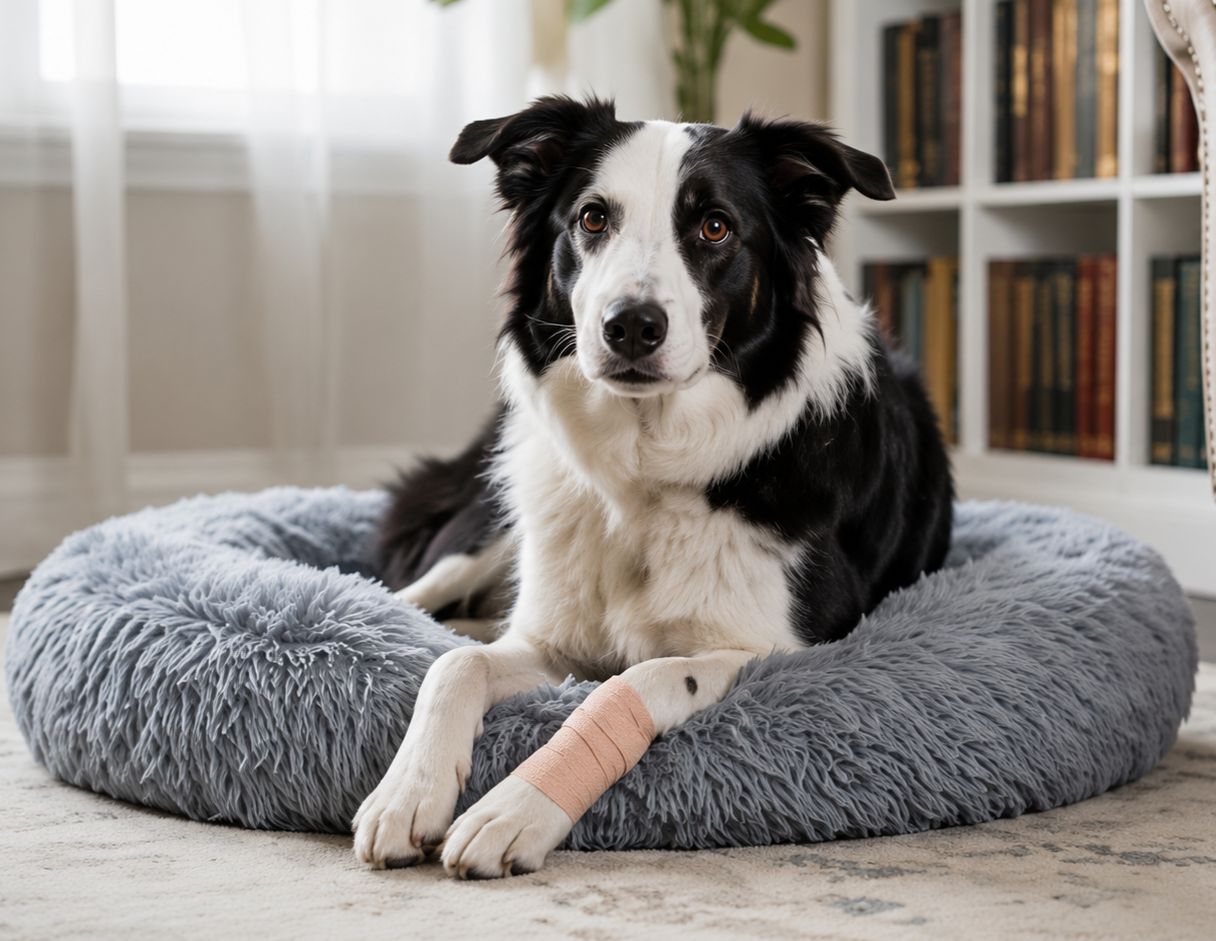
Dog leg amputation removes a limb that causes more pain, infection risk, or nerve damage than it can recover from. Most dogs walk with support within days of surgery, reach a stable gait on three legs within four to six weeks, and go on to run, climb stairs, and play much as before.
Why This Decision Feels Bigger Than It Is
Osteosarcoma, the most common cause of leg amputation in dogs, accounts for more than 80% of bone tumors diagnosed in dogs, according to the Merck Veterinary Manual. That single fact explains why so many owners hear the word amputation for the first time during what already feels like the worst week of the year. The surgery itself is not the hard part for most dogs. The hard part is the decision, made by an owner who is picturing a limp, a missing leg, and a dog who has to relearn how to move, none of which resembles what actually happens once the pain is gone and the incision has healed.
What Actually Causes a Dog to Need an Amputation
Bone Cancer
Osteosarcoma typically appears in a leg as a swelling or a limp that does not resolve with rest, and it grows fast enough that by the time it is diagnosed, the bone underneath is usually too damaged to repair. Large and giant breed dogs are diagnosed more often than small dogs. Amputation is the standard first step because it removes the pain source immediately, and it is often performed alongside the practice’s tumor removal surgery when cancer elsewhere needs to be addressed at the same time.
This is also where a harder conversation belongs, and it is worth having before surgery, not after. According to the Merck Veterinary Manual, median survival after amputation alone for osteosarcoma is 4 to 6.5 months; amputation combined with chemotherapy extends that to roughly 9 to 12 months. Amputation relieves pain reliably. It is not, on its own, a cure for the cancer that usually causes it. A veterinarian will walk through what that means for a specific dog’s diagnosis and stage before recommending a path forward.
Trauma
A car accident, a fall, or a dog fight can damage a limb badly enough that its blood supply or nerve function is gone for good. When that happens, no amount of splinting or repair brings the leg back to function. Dog leg amputation becomes the option that resolves the ongoing pain and infection risk a nonfunctional limb creates.
Chronic Infection or a Wound That Will Not Close
Some bone infections and long-standing wounds stop responding to antibiotics and repeated cleaning. At that point, amputation removes the infection’s source, which is often the only thing that actually resolves it.
A Limb That Never Developed Normally
A small number of dogs are born with a limb that causes chronic pain or never functioned properly. Amputating it early, while the dog is still young, tends to go more smoothly than waiting, since a young dog has not yet built movement habits around a leg that never worked right to begin with.
Amputation Versus Trying to Save the Limb
A veterinarian weighs amputation against limb-sparing surgery before recommending either one. The comparison below is the honest version of that, including where limb-sparing genuinely wins.
| Factor | Limb-Sparing Surgery | Amputation |
| Best candidate | A structurally salvageable limb with localized, treatable damage | Extensive damage, an aggressive tumor, or a nonfunctional limb |
| Number of procedures | Often more than one, plus follow-up imaging | Usually one surgery |
| Long-term joint load | Stays on four limbs, but the repaired limb may bear weight unevenly | Redistributes weight onto three limbs permanently |
| Not a good fit for | A dog with a tumor that has already invaded surrounding tissue | A dog with severe arthritis already affecting the other three limbs |
Before either option, a veterinarian confirms the diagnosis with X-rays and bloodwork, and when cancer is suspected, chest imaging to check whether it has already spread to the lungs. That workup happens through the practice’s on-site diagnostics, and the single finding it turns up changes what the rest of treatment looks like.
What Happens on Surgery Day
A dog goes under general anesthesia, and the surgical team monitors heart rate, blood pressure, and oxygen levels for the duration of the procedure. Local nerve blocks are used alongside anesthesia, which is what keeps most dogs noticeably more comfortable coming out of surgery than owners expect walking in. The amount of limb removed depends entirely on where the damage sits. Front leg amputations tend to need a slightly longer adjustment than hind leg amputations, since a dog’s front legs carry more of its body weight during normal movement.
Most dogs stay in the hospital one to two nights afterward. That range is a general post-surgical figure, not specific to any one practice, and it can run longer for an older dog or a more complex case. A dog typically goes home once eating, urinating normally, and able to stand with minimal help. The practice’s amputation surgery page has more on how the surgical visit itself is structured.
The First Two Weeks of Dog Leg Amputation Recovery
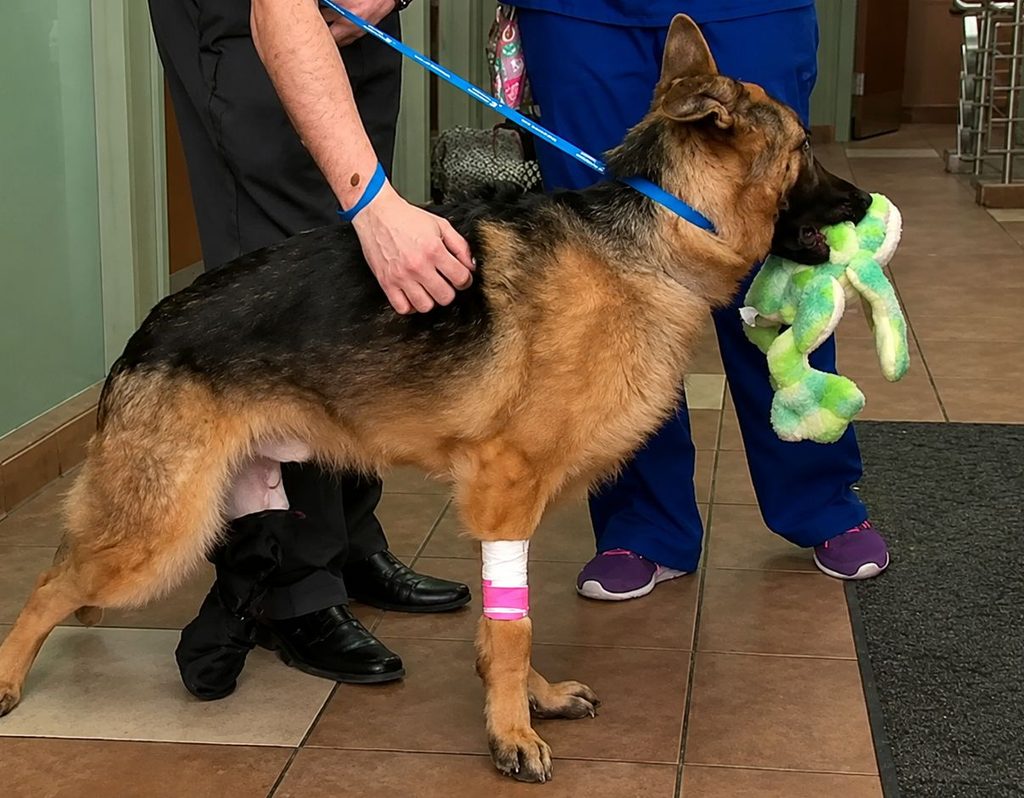
The early days ask more of the owner than of the dog, mostly in the form of watching closely rather than doing much.
- Keep the dog in a small, non-slip space for the first week. A slick kitchen floor is a bigger risk right now than it looks.
- Give every dose of pain medication on schedule, not just when the dog seems uncomfortable.
- Check the incision once a day for swelling, discharge, or a smell that was not there yesterday.
- Keep activity to short leash walks only, until the incision is fully closed, usually around the two-week mark.
- Expect an off day or two. It happens, and it does not mean something has gone wrong.
Call the veterinarian right away, rather than waiting for the next scheduled visit, if the incision reopens, a fever develops, the dog stops eating entirely, or pain seems to be getting worse instead of better after the first few days. None of these are common. All of them are worth a same-day call when they happen.
How Long Until a Dog Is Walking Normally Again
Most dogs reach a stable, confident three-legged gait somewhere between four and six weeks after surgery. Younger, otherwise healthy dogs often get there faster. Larger dogs, and dogs who already had arthritis in one of the remaining legs before surgery, generally take longer and sometimes need ongoing joint support for the rest of their lives. A full return to their old activity level is not guaranteed for this group. That is worth naming directly, because most articles on this topic skip it: amputation solves the problem in the amputated limb, but it does not undo joint disease that was already present somewhere else.
Weight matters more after amputation than before it, since three legs are carrying the load four used to share. A veterinarian can set a target weight and a feeding plan suited to the dog’s new activity level, and the practice’s weight management guidance covers the same principles for a three-legged dog. Raising it at the two-week recheck, before weight gain becomes a habit, is easier than correcting it later. For a dog whose gait stays uneven longer than expected, it is worth asking directly about veterinary orthopedic manipulation; owners sometimes assume nothing more can be done, and that assumption is often wrong.
Where Recovery Genuinely Gets Harder
Not every dog adapts to leg amputation on the timeline above, and the standard veterinary line, that dogs “do great on three legs,” is true often enough to be repeated everywhere and incomplete often enough to be worth qualifying. A dog with hip or elbow arthritis already present in a remaining limb before surgery carries real risk of that joint deteriorating faster once it takes on more weight. Some dogs also experience what is described in human amputees as phantom limb sensation, discomfort or reactivity localized to where the leg used to be. It is difficult to diagnose definitively in a dog, since a dog cannot describe what it is feeling, but it is a real and documented possibility. A veterinarian is worth consulting directly if a dog seems unsettled by something that is not visibly there anymore. The practice’s post-surgical comfort guidance applies here too, particularly during the weeks when a dog is still adjusting.
Giving a Dog the Best Path Forward
At Kainer Veterinary Hospital, Dr. Daniel Kainer and the surgical team evaluate each dog’s diagnosis, imaging, and overall health before recommending amputation, limb-sparing surgery, or another path entirely. The practice serves The Woodlands, Conroe, Montgomery, and the surrounding area. Contact the practice to discuss a specific diagnosis and what the options actually look like for that dog.
FAQs
Q: How do veterinarians decide a dog needs leg amputation?
A: A veterinarian recommends amputation once imaging and bloodwork confirm a limb is too damaged, diseased, or painful to save, most often from an aggressive bone tumor, severe trauma, or an infection that has stopped responding to treatment. The decision follows diagnostic imaging, not a single physical exam.
Q: Is recovery harder after a front leg amputation than a hind leg amputation?
A: Front leg amputations generally involve a longer adjustment than hind leg amputations, since front legs carry more of a dog’s body weight during normal movement. Most dogs still reach a stable gait within a comparable overall timeframe.
Q: How long does dog leg amputation recovery take?
A: The incision typically heals within about two weeks, and most dogs reach a stable three-legged gait within four to six weeks. Larger dogs and dogs with pre-existing joint disease in a remaining limb often need longer and more ongoing support.
Q: Does amputation cure the cancer that caused it?
A: Not on its own. For osteosarcoma, median survival after amputation alone is roughly 4 to 6.5 months; adding chemotherapy extends that to about 9 to 12 months, according to the Merck Veterinary Manual. Amputation reliably relieves pain, which is separate from whether it addresses the underlying cancer.
Q: Where can a dog get a surgical evaluation for a limb injury or tumor in The Woodlands area?
A: Kainer Veterinary Hospital provides diagnostic imaging and amputation surgery for dogs across The Woodlands, Conroe, Montgomery, and surrounding communities. Contact the practice to schedule an evaluation for a dog diagnosed with a condition affecting a limb.